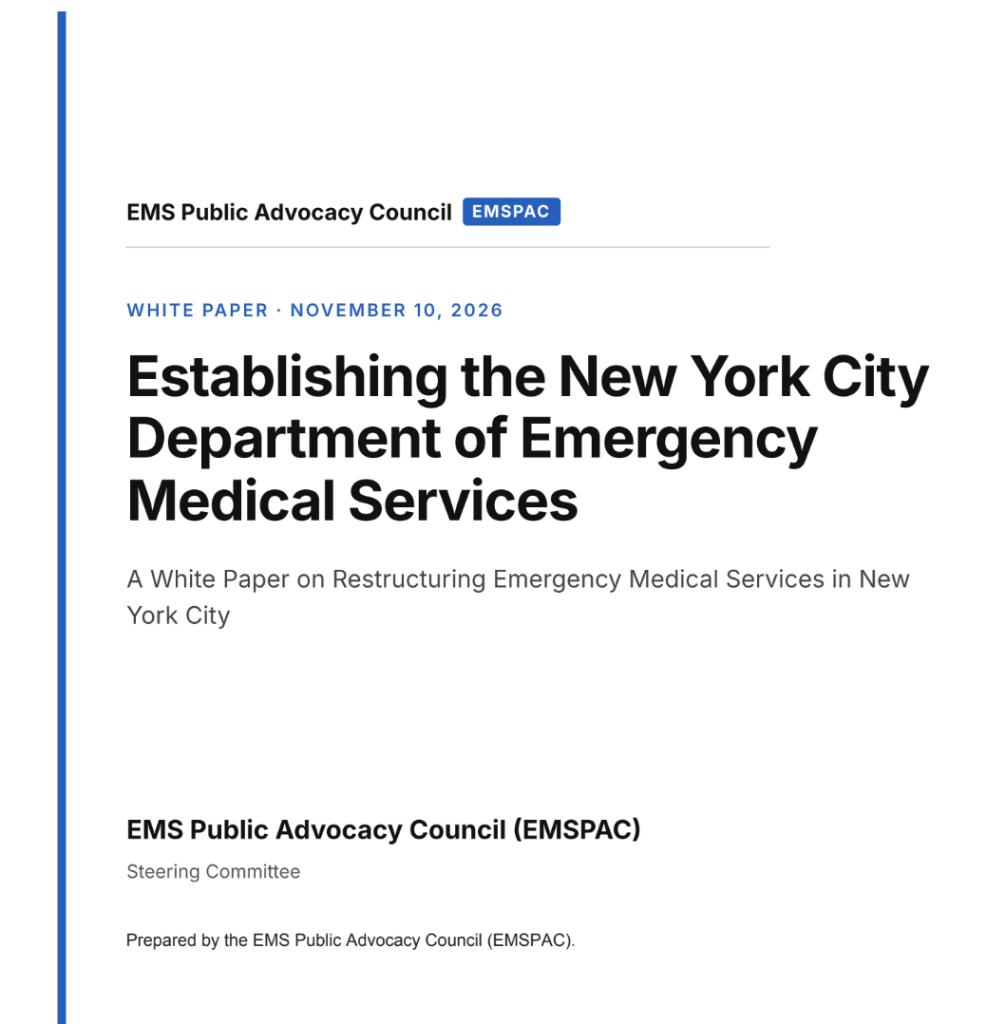
RE: EMSPAC Joint Statement on the NYC Department of EMS
Nov. 10th, 2026
On behalf of the Steering Committee of the Emergency Medical Services Public Advocacy Council (EMSPAC) and the EMS Political Action Committee (EMS PAC) of the State of NY.
New York City needs an independent Department of Emergency Medical Services. EMS is not a subsidiary function of firefighting. It is an independent public safety and healthcare profession that deserves its own municipal department, leadership, budget, workforce structure, and systemwide authority.
The FDNY has had 30 years to establish a quality EMS bureau for New York, but it has chosen instead to bleed EMS dry for the benefit of firefighter job security.
EMS is more than an ambulance responding to a call; we are an “essential public service” and a critical component of both the public safety and healthcare systems. EMS meets the basic economic definition of a “pure public good”; our availability, readiness, and ability to respond to medical emergencies provide substantial benefits to society that extend well beyond the individual patient.
In economic terms, public goods are distinguished by two defining principles: non-excludability and non-rivalry. These concepts are especially relevant to the public responsibility to maintain an emergency medical response system. When someone calls 911, access to emergency medical assistance is not ordinarily determined by their ability to pay, financial circumstances, or insurance coverage. Universal access, shared readiness, and communitywide benefit reinforce the argument that EMS should be recognized, funded, and maintained as an essential public service rather than evaluated primarily by the revenue generated by individual patient encounters.
A properly funded EMS system does more than save lives. It provides timely clinical interventions, reduces preventable death and disability, facilitates appropriate access to healthcare, and has the potential to reduce avoidable emergency department utilization and downstream healthcare costs. These benefits extend to patients, hospitals, healthcare systems, and the communities they serve. The economic value of EMS, therefore, cannot be measured simply by ambulance transports, reimbursement revenue, or response times. It must also be measured by the lives preserved, the suffering alleviated, and the broader healthcare resources that an effective EMS system helps protect.
Today, 75 % of all 911 calls are Medical in nature, while only 17% of the 2.7 billion is being used to support EMS operations. Hundreds of EMS personnel are leaving the field. This has caused an ambulance shortage across all sectors and is driving up response times, which in turn costs human lives.
New York City should establish a standalone New York City Department of Emergency Medical Services (NYC DEMS) that assumes responsibility for all municipal 911 ambulance operations, integrate the existing FDNY EMS workforce and infrastructure, and establishes uniform operational standards for every ambulance provider operating within the city’s emergency medical response system.
Former City Council member Justin Brannan introduced a bill in 2024 to form a Department of EMS for New York City. City Council member Susan Zhuang is reintroducing it as a response to the current EMS Crisis. Rising response times, rising call volume, embarrassing wages, low morale. Conditions that are causing many to walk off the job.
This is not an indictment of the FDNY or its firefighters. It is a case for recognizing EMS as its own “essential”, “uniformed”, public health & safety discipline. Distinct from Fire and Policing, but immediately adjacent to them, deserving comparable funding and respect.
- EMS Needs Its Own Institutional Identity
New York City has built an emergency medical response system that serves millions of residents, yet its municipal EMS workforce remains institutionally housed within the FDNY, while a substantial portion of its 911 ambulance coverage is provided by independent hospital organizations. This fragmented structure creates challenges in workforce development, financial accountability, long-term planning, and systemwide coordination.
We propose establishing an independent New York City Department of Emergency Medical Services. The new department would absorb all existing municipal 911 ambulance operations, including FDNY EMS personnel, ambulances, stations, equipment, and associated administrative resources. It will also establish uniform operational standards for all hospital-based, private, and volunteer ambulance providers participating in the City’s emergency medical response system.
The FDNY was built around fire suppression, fire prevention, rescue, and emergency response. EMS has a different primary mission: preservation of human life and alleviation of human suffering. Emergency medical assessment. Advanced and basic life support. Prehospital emergency medicine. Trauma stabilization. Cardiac and respiratory emergencies. Mass casualty medical operations. Emergency medical transportation. Community paramedicine and preventive healthcare. Behavioral health responses. Although these functions can overlap with fire and rescue operations, they require a completely different professional culture, training infrastructure, staffing model, and long-term development strategy. EMS should not have to compete institutionally with firefighting for recognition, resources, or organizational priorities. The “promotional exam” has greatly harmed EMS workforce retention. It attracts people into EMS who do not truly want to be in healthcare, and regularly hemorrhages hundreds from the workforce. It all but ensures ongoing attrition of the service.
The argument for an independent EMS department extends beyond professional identity and organizational structure. EMS must be recognized as an essential public service whose value cannot be measured solely through the number of ambulance transports or the revenue those transports generate. EMS systemwide readiness, emergency preparedness, and universal availability produce substantial public benefits that extend beyond the individual patient. Like police and fire protection, EMS exists because society has determined that access to emergency assistance should not depend on an individual’s financial circumstances or ability to purchase services in a competitive marketplace. Establishing an independent department acknowledges that EMS is not simply another healthcare business, but an essential component of the public safety infrastructure for which government bears ultimate responsibility. It recognizes that EMS is an essential service, but more importantly, that it is a public good.
- EMS Needs Its Own Budget and Financial Accountability
EMS is revenue-generating. EMS calls are billable. EMS should not be used to subsidize a decreased need for firefighting. EMS should have an independent municipal budget, rather than being administratively situated within a much larger fire department. The October 2026 NYC Comptroller’s Report: A System Under Strain: FDNY EMS Operations and Fiscal Pressures, identifies significant structural problems: EMS responses account for more than 75% of FDNY emergency responses. EMS personnel account for less than one-third of FDNY personnel. EMS expenditures increased 68% between FY2015 and FY2026. More than 500 EMTs left their positions in FY2026. Experienced EMTs earn substantially less than firefighters. As things currently stand, hospital-based and private sector EMS workers are handling over 35% of all daily EMS calls. This call volume of 5500 to 6000 does not include several hundred more calls being taken off the board by volunteers and commercial interfacility transport EMS.
These figures demonstrate the scale of the EMS mission and the workforce challenges facing the system. If EMS is responsible for delivering the majority of emergency responses, it deserves an institutional structure that reflects that responsibility.
It is often repeated over and over again that “there is no money in 911”, but were that the case, why are there 70 different agencies providing units? That is because hundreds of millions in billable revenue is changing hands. That is because patient steering is occurring on a widespread basis. That is because of widespread misuse and abuse. It is because of integrated systems that allow private benefit and private inurement.
The bill for an ambulance ride just went up in July. $1,793 (BLS) to $2,212 (ALS). January 1st, they will begin charging patients for “treat in place”: $ 896 (BLS)- $ 1,098 (ALS). $20 per mile and $66 when you give oxygen. Hundreds of millions are earned every year by FDNY EMS, but it does not ever go back to the EMS Bureau. For every patient an ambulance brings to the hospital, the bill can be $5000 to $8000 to be there for 4-8 hours. A high-acuity admitted patient will run up tens of thousands of dollars. One patient with a Stroke or a STEMI might very well fund an entire EMS unit for a month. The reality is that healthcare is a multi-billion-dollar business and EMS is its driving force. Yet, while all that profiteering is going on, the public still expects an ambulance to arrive in a timely fashion. As if we were essential.
One of the fundamental economic challenges confronting EMS is the disconnect between how emergency medical services are financed and what communities actually expect those services to provide. Traditional ambulance reimbursement mechanisms have historically emphasized patient transportation rather than the broader costs of maintaining continuous emergency medical readiness. Yet the financial obligations of an EMS system exist regardless of whether an ambulance transports a patient. Personnel, vehicles, communications, training, medical oversight, equipment, and geographic coverage must be maintained around the clock. An independent Department of EMS would provide New York City with an opportunity to establish a more transparent financing structure that distinguishes the cost of maintaining system readiness from the revenue generated through individual patient encounters. This distinction is essential to developing a financially sustainable emergency medical system.
New York City is the hub of the financial world. The day after any governmental economics report is published; after any election; or after a world crisis, everyone checks to see how Wall Street reacts. If any city can find an answer to how we finance a system of care, it is New York City. At least 1000 of the daily 5500 calls relate to the overconsumption of alcohol, and it is time to tax distributors, restaurants, clubs, bars, and consumers of this level of self-destructive public health hazard.
In the Citizen Budget Commission Report Reviving EMS, “The use of fire engines in addition to ambulances as a response to medical incidents is wasteful; the heavily staffed fire engines are far more expensive than ambulances as a response, and in many of the incidents to which they respond, fire engine personnel are not able to deal effectively with the medical condition.” They called on the FDNY to greatly reduce dispatch of units to non-emergencies and consider EMT/Paramedic staffing.
Financial independence must also be accompanied by revenue diversification and long-term fiscal planning. An EMS department dependent primarily upon ambulance reimbursement remains vulnerable to changes in Medicare and Medicaid payment policies, payer mix, uncompensated care, and fluctuations in transport volume. These financial uncertainties are particularly concerning when the underlying obligation to maintain emergency medical coverage remains constant. New York City should therefore evaluate a financing model that combines dedicated municipal appropriations, appropriate reimbursement revenue, and other legally authorized funding mechanisms to support the full cost of EMS operations. Such a structure should include transparent cost accounting, multiyear financial forecasting, and dedicated investment in capital replacement, workforce development, and emergency preparedness. The objective should not simply be to establish a separate EMS budget, but to create a sustainable financial foundation for an essential municipal service.
- Absorb All Municipal 911 Ambulance Operations
The proposed Department of EMS should consolidate the City’s municipal, hospital-based, and private ambulance operations under one unified organization. This cannot happen overnight, but there must be a long-term plan for absorption and industry-wide regulation.
This will include absorbing:
- FDNY EMS EMTs and paramedics.
- EMS supervisors and administrative personnel.
- Municipal ambulance fleets.
- EMS stations and deployment infrastructure.
- EMS training facilities.
- EMS communications and dispatch functions.
- EMS medical logistics and operational support.
- EMS-specific budgetary resources.
- Existing FDNY EMS employees should transition into the new department with appropriate protections for their seniority, compensation, benefits, pensions, collective bargaining rights, and promotional opportunities.
- Firefighters would remain within the FDNY.
The result will be three independent but coordinated public safety departments.
FDNY: Fire suppression, rescue, fire prevention, and related emergency operations.
NYPD: Law enforcement and public safety.
DEMS: Emergency medical response, prehospital medicine, ambulance operations, and systemwide EMS administration.
This will include systematically absorbing on a defined timeline:
- Hospital-based EMS EMTs and paramedics.
- Hospital-based EMS supervisors and administrative personnel.
- Hospital-based ambulance fleets.
- Existing Hospital-based EMS employees will have the opportunity to transition into the new department, with appropriate protections for their seniority, compensation, benefits, pensions, collective bargaining rights, and promotional opportunities.
This will include regulating:
- Removing commercial subcontracting from the 911 system.
- Commercial EMS EMTs and paramedics operating in the 911 system.
- Commercial EMS EMTs and paramedics engaged in interfacility transport.
- Commercial EMS engaged in non-ambulance settings.
- Commercial EMS management compelling employees to use lights and sirens to expedite non-emergency calls.
This will include regulating and then gradually phasing out:
- Volunteer EMS EMTs and paramedics
- EMS volunteer agencies that discriminate based on identity whether they transport, or, subsequently, call for private EMS to come transport.
- EMS volunteer agencies routinely using lights and sirens while transporting stable patients between boroughs.
- Establish One Set of Standards for Every EMS Provider
It is holding down our wages to have so many different providers. It is harming union bargaining strength by spreading our members across too many sectors. It is harming patients by lowering standards implicit in an inexperienced, transitory workforce.
All EMTs and paramedics must not only fall under one regulatory regime, but must eventually be integrated into one department. This may be one of the most important reasons for creating an independent department. New York City’s 911 ambulance system is not exclusively municipal. As it currently stands, only 60% of 911 calls are handled by FDNY EMS municipal providers. Hospital-based providers handle 30%, and commercial EMS subcontracted to hospitals that cannot afford their own EMS Dept. handles 10%. Commercial EMS and volunteer EMS handle hundreds of calls each day outside the 911 system.
Today, our FDNY EMS/NYC EMS system includes:
- 70 EMS deploying agencies across multiple sectors
- REMSCO-dominated protocols and credentialing
- FDNY-operated ambulances
- Hospital-based voluntary ambulances.
- Hospital-based voluntary ambulances participating in interfacility transport operations.
- Private ambulance providers participating in emergency operations.
- Private ambulance providers participating in interfacility transport operations.
- Private ambulance providers employed at construction sites, event medicine, and concierge medicine.
- Volunteer ambulance organizations participating in authorized emergency response and mutual aid.
The NYC Independent Budget Office has documented that approximately one-third of the 911 ambulance system is operated by non-FDNY providers. The City needs a centralized EMS authority capable of establishing consistent requirements across the system. The Department of EMS should establish and enforce uniform standards covering:
- Dispatch Categorization: Our triage system is broken and inappropriately up-triages and overutilizes CFRs.
- CFRs are not only expensive; they have highly limited medical value and no transport capability.
- Proposed citywide standards set by the EMS Dept., not a not-for-profit.
- Staffing: begin FF/EMT units, EMT/Social Worker units (B-HEARD); EMT/Medic units, Medic/Medic units; and Dual Medic Rescue units.
- Minimum staffing requirements are not in line with national standards
- Uniformed Compensation: set wage minimums pegged to PD, Fire, Sanitation (uniformed status)
- Set Minimum compensation standards for all sectors using EMS employees
- Standardize Uniform; one EMS uniform
- Standardized ambulance equipment
- Standardize Citywide EMS identification standards
- Better Training; Continuing education and competency requirements
- More advanced Medical protocols with consistent clinical standards
- Joint Deployment until integration; set a timeline for integration but allow all sectors to be authorized (VAX’d) across all EMS work sites.
- Improve geographic coverage requirements and reduce reliance on CFRs
- Improve response times
- Set measurable performance standards and reward meritorious/ liefe saving accomplishment
- Set strict vehicle maintenance guidelines
- Set Uniform inspection requirements
- Improve overall Employee safety
- Standardize PPE, workplace safety, and violence prevention
- Adhere to better Labor standards and set Minimum employment and workplace protections
- Enable transparent employee Reporting
- Standardized operational and financial reporting
- Return EMS revenue to the EMS Department
- Demonitize actual emergency EMS as a public good
- Fully centralize EMS education, credentialing, and hiring
The objective is not necessarily to eliminate different employers. It is to eliminate unnecessary differences in the quality, accountability, and operational expectations of the emergency medical response system.
Workforce development must also be understood as a long-term investment in human capital rather than simply an operating expense. Every experienced EMT or paramedic who leaves the profession represents the loss of institutional knowledge, clinical experience, and public resources invested in recruitment, education, training, and professional development. High turnover imposes costs that extend beyond replacing an employee, including additional overtime, recruitment expenditures, training requirements, and potential reductions in operational efficiency.
A financially responsible EMS system must therefore evaluate compensation, career advancement, professional development, and employee retention as interconnected components of organizational performance. An independent Department of EMS would provide the institutional framework necessary to make workforce stability a measurable financial and operational priority rather than treating employee turnover as an unavoidable cost of providing emergency medical services.
- Establish a Central Authority for All NYC EMS Providers
This all but necessitates absorbing REMSCO into the proposed Department of EMS. There should not be a not-for-profit third party arbitrating protocols, credentialing, and who gets a certificate of need.
The proposed department should not simply become another municipal ambulance employer.
It should become the central coordinating and regulatory authority for the City’s operational EMS system, within the authority granted by state law. That means establishing consistent requirements for municipal, hospital-based, private, and volunteer providers.
It will have responsibility for:
- Provider accreditation and city authorization.
- Operational inspections.
- Ambulance deployment standards.
- Emergency preparedness.
- Systemwide performance monitoring.
- Mutual aid coordination.
- Training and credentialing oversight.
- Provider accountability.
- Public reporting.
Clinical governance must remain consistent with New York State Department of Health requirements and the statutory authority of the Regional Emergency Medical Services Council and Regional Emergency Medical Advisory Committee. New York already has a statewide EMS regulatory framework under Public Health Law Article 30. The proposed department would provide the municipal operational structure necessary to coordinate the system locally. REMSCO and REMAC will have to be absorbed into the new Department.
This will include absorbing:
- REMAC’s medical director credentialing
- REMAC’s protocol formation and paramedic credentialing
- REMSCO’s certificate of need regulation
- REMSCO’s peer support mechanisms
- All of their CME and Committee functions
This will include absorbing:
- All EMS training facilities under one standardized Academy with satellite sites in all 5 boroughs. This system should integrate with CUNY for an ASA in Paramedicine, a BS in Paramedicine, and eventually an MS for EMS Administration/leadership
- Stop Allowing Hospital Financial Decisions to Determine Ambulance Availability
One of the structural vulnerabilities of the current system is its dependence on voluntary hospital participation. Hospitals can reduce their ambulance commitments or withdraw units. When they do, FDNY must absorb the resulting coverage gaps.
The NYC Comptroller identified this problem in the October 2026 report. The City has increasingly needed to backfill ambulance tours abandoned by non-FDNY providers. This creates a fundamental problem: The availability of emergency medical services should not depend on whether an individual hospital considers operating ambulances financially advantageous.
EMSPAC warns that these 2026 cuts are part of a broader trend of hospital-based EMS reductions across New York City, including similar reported changes within Northwell-affiliated EMS operations, which cut back 5 units last year: 1 in Staten Island, 1 in Queens, and 3 in Manhattan. The continued contraction of hospital-based 911 participation is expected to place additional strain on FDNY EMS, which is already facing staffing shortages, recruitment and retention challenges, and increasing system demand. Maimonides, which supplies 19 units to the 911 system, has become City Hospital; the status of its EMS fleet in the long term is unclear. New York Presbyterian cut 6 night tours on units across the city in July. RUMC cut tours and units. There is a high probability that RUMC will also be sold to the HHC system, and all EMS units will be shut down.
The full damage impacts of healthcare cuts under the One Big Beautiful Bill are not yet in full effect. Expect more Hospitals to run down 911 units and implement their own means to transport their own patients..
- The New Department
The Department of EMS will be a third service municipal agency. It will seek 100% control of the 911 response system; Operation of all City 911 ambulances; control of all HHC interfacility units; all B-HEARD units; all HAZMAT, all Rescue. It will be a central coordination and leadership department for all EMS in all sectors, including Community Paramedicine and EMS Clinical Training. A proposed organizational structure:
Office of the Commissioner
Chief of EMS Operations
Bureau of Municipal EMS- Direct operations of city-funded staff & fleet
- 911
- HHC IFT
- B-HEARD
- Hazmat
- Rescue
- Community Paramedicine
Bureau of Voluntary EMS– Oversight, integration, and absorption of all EMS assets in the 911 system or adjacent.
- Oversight of non-municipal EMS units still in the system
- VAX’d personnel from hospital/ private sector may cover shifts on municipal units
- Voluntary/Private Units scheduled for absorption
Bureau of Emergency Communications
- Medical dispatch/Improved Call Triage/ Capability to dispatch Uber and private EMS transport
- Call taking and coordination; Diversions out of 911 system
Bureau of Fleet and Logistics
- Ambulances, equipment, and facilities
Bureau of Clinical Affairs
- Online Medical Control
- New EMS training (BOT)
- Medical direction and quality assurance
- Continuing Medical Education/ Call Review/Recredentialing
Bureau of Research and Performance
- Data, response times, and system evaluation
- Rewarding high-quality performance with higher compensation
- The Bureau of Research and Performance should be responsible for evaluating not only operational efficiency but also the broader clinical, economic, and societal value of the EMS system.
- Response times and transport volumes remain important indicators, but they do not independently establish whether an emergency medical system is delivering effective care or using public resources responsibly.
- Performance evaluation should incorporate clinically meaningful patient outcomes, geographic equity, workforce stability, unit-hour utilization, system readiness, and the cost-effectiveness of alternative deployment and care models.
- Particular attention should be directed toward determining whether appropriate prehospital interventions, alternative care pathways, and community-based programs can reduce avoidable emergency department utilization and downstream healthcare expenditures without compromising patient safety. These measures would allow policymakers to evaluate EMS as an integrated public health and safety system rather than simply a fleet of ambulances responding to calls.
Bureau of Labor and Employee Relations
- Workforce policy and ongoing labor union relations
- Replaces BITS in investigating disciplinary action complaints
Bureau of Workforce Development
- Human resources focused on recruitment, retention, training, morale, and career advancement
- Valuing education and clinical advancement
The department would also maintain formal operational relationships with FDNY, NYPD, NYC Health + Hospitals, NYC Health Department, hospitals, and other emergency response agencies.
- Other Jurisdictions
U.S Cities operating independent third-service EMS systems include Austin, Texas; Boston, Massachusetts; Pittsburgh, Pennsylvania; Cleveland, Ohio; Fayetteville, North Carolina; and Baton Rouge, Louisiana. Other examples include Minneapolis, Minnesota, and New Castle County, Delaware. These jurisdictions operate dedicated EMS agencies separate from their fire departments, demonstrating that emergency medical services can function as an independent municipal public safety service. Where this has occurred, there are notable differences in retention levels, compensation, and the clinical sophistication of the protocols.
United Kingdom, South Africa, Israel, Australia, Poland, Ireland, New Zealand, the Czech Republic, Croatia, Latvia, France, Norway, the Netherlands, Finland, Russia, China, and Canada all operate EMS as independent third services separate from Police and Fire. Many of these systems have M.S. level training. Many have a title that does not exist in the U.S., called “Paramedic Practitioner,” and have highly developed systems which are capable of rapid emergency medical response and interfacility transport, as well as mobile integrated care, i.e., community paramedicine.
New York is not obligated to permanently maintain its current organizational arrangement. It was forced upon us by the FDNY refusing to take EMS seriously. The FDNY maldeveloped EMS and thirty years later is wondering why no one wants to work in EMS. There are different models of municipal EMS administration across the country, including independent third-service EMS agencies, fire-based EMS, and hospital-based systems. The relevant policy question is which organizational structure best supports New York City’s exceptionally large and complicated emergency medical system. An independent department would allow the City to evaluate EMS as a standalone public service rather than as one component of a fire department.
Our objective is not to diminish the history and importance of the FDNY. There may well be practical configurations that include its personnel in EMS responses. We have to recognize that firefighting and emergency medical services are distinct professions with different operational requirements, workforce needs, and institutional responsibilities.
The people who provide emergency medical care should have a department that exists to advance, protect, professionalize, and improve EMS for the sake of both patients and the providers. New York City needs an independent Department of Emergency Medical Services to reduce response times, rein in the many unaccountable actors profiting off the broken system, and improve patient care for all New Yorkers.
One City. One Profession. One Service. Vote YES for the Department of EMS.
On behalf of the Steering Committee of the Emergency Medical Services Public Advocacy Council (EMSPAC) and the EMS Political Action Committee (EMS PAC) of the State of NY.

