
E M S P A C
EMERGENCY MEDICAL SERVICE PUBLIC ADVOCACY COUNCIL

The Fire Department of the City of New York (FDNY, or the Department) is the nation’s largest fire department, responding to more than one million emergency incidents each year.1 Its core missions are to protect life and property from fire and other emergencies, and to respond to medical incidents. As of the City’s FY 2027 Adopted Budget, the FDNY has the seventh largest budget of all City agencies ($2.7 billion), supporting fire extinguishment and emergency response, fire investigations, fire prevention, and Emergency Medical Services (EMS).2 EMS professionals provide life-saving pre-hospital care to New Yorkers every day. This report examines how EMS operates within the FDNY and the key challenges facing NYC’s emergency response system: high incident volumes and response times, persistent workforce challenges with disproportionately high attrition rates and low wages for EMS personnel, and a structural gap between the rising cost of providing care and reimbursement rates. The lack of a contract for EMS workers has contributed to salary differences in recent years. Together, these forces are placing increasing and mutually reinforcing strains on the City’s emergency response system.

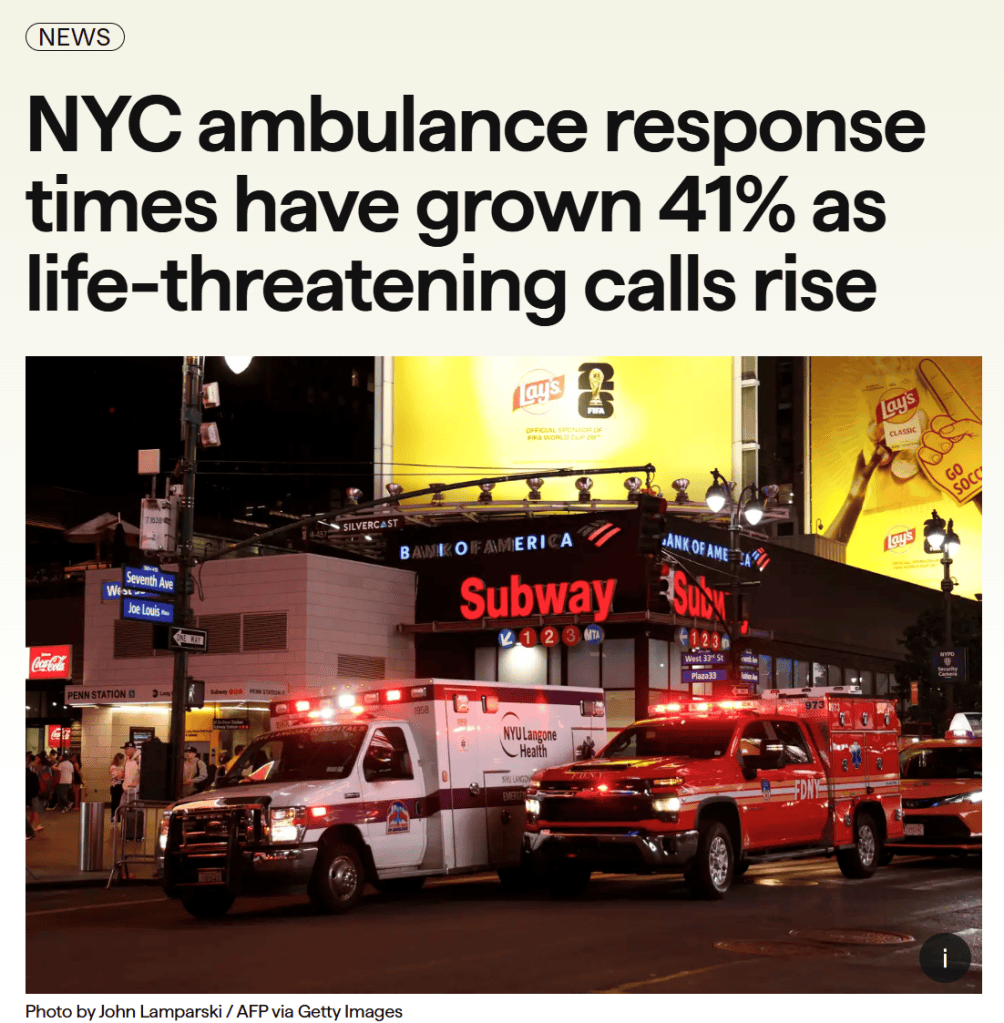
GOTHAMIST-NYC Ambulance Response Times Grown by 41%
New York City’s emergency medical response teams are taking longer to get to people in distress, even as life-threatening emergencies are spiking, a report by the city comptroller’s office found.
The report examined a decade of FDNY data, including information about the calls that the department’s emergency medical services responded to between fiscal years 2015 and 2026. It found life-threatening medical emergencies in that period increased more than 22%.
A spokesperson for the comptroller said they did not know the reason for the uptick in life-threatening emergencies.
Also in the last decade, FDNY response times for those emergencies grew by three minutes and 50 seconds, a more than 41% increase, the report found. Response times for non-life-threatening emergencies more than doubled in that time period, according to the report.

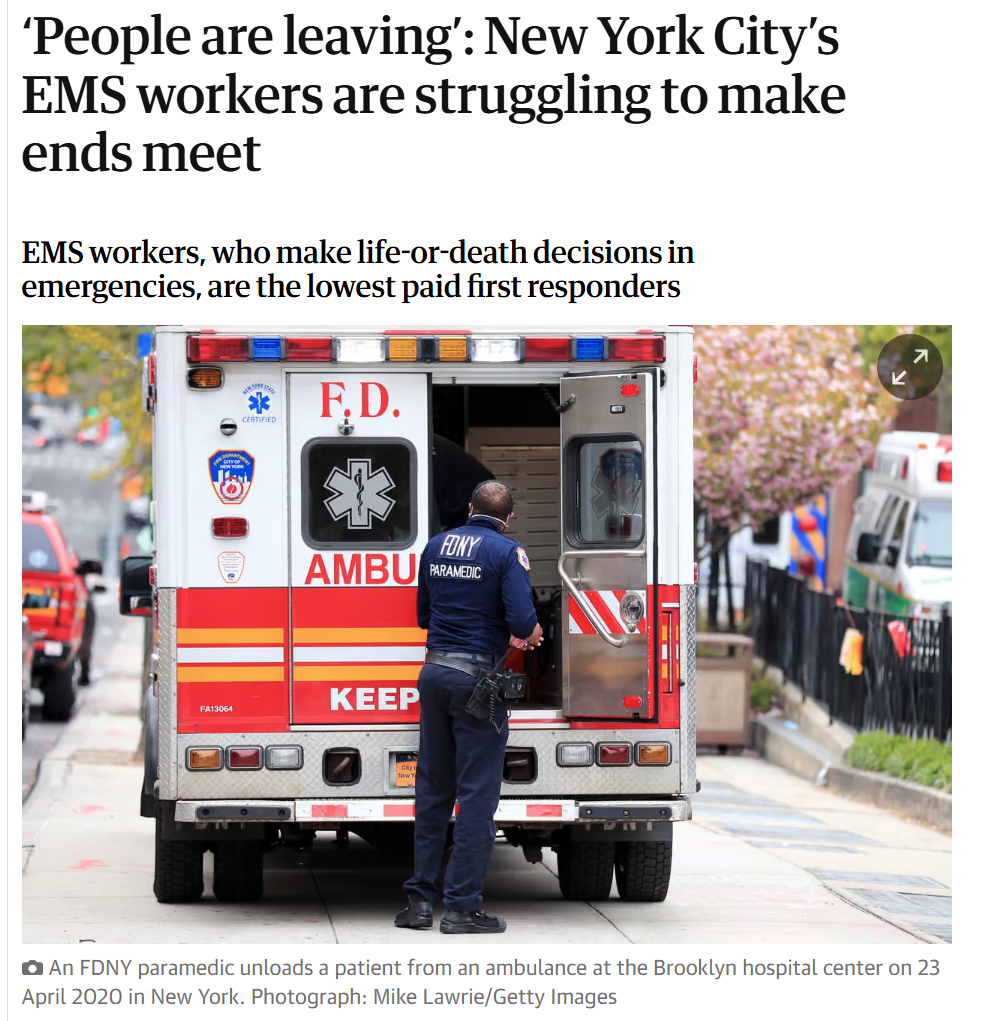
After 31 years in New York City’s emergency medical services, Oren Barzilay has started giving young New Yorkers advice he never imagined giving when he began his EMS career. “Don’t come here,” he tells them. “You are only going to hurt yourself.”
It is a striking reversal for Barzilay, the recently retired president of FDNY EMS Local 2507. What changed for Barzilay was not his view of work or the value of service. It was what he believes is the New York City failure to pay the people who put their lives at risk to save the lives of others.
“After 31 years, I am stuck at $59,000,” he said.
Barzilay’s reversal comes as New York City’s EMS workforces remain locked in a years-long fight over wages and pay parity. The fight has become an early test of a contradiction facing Mamdani’s young administration.

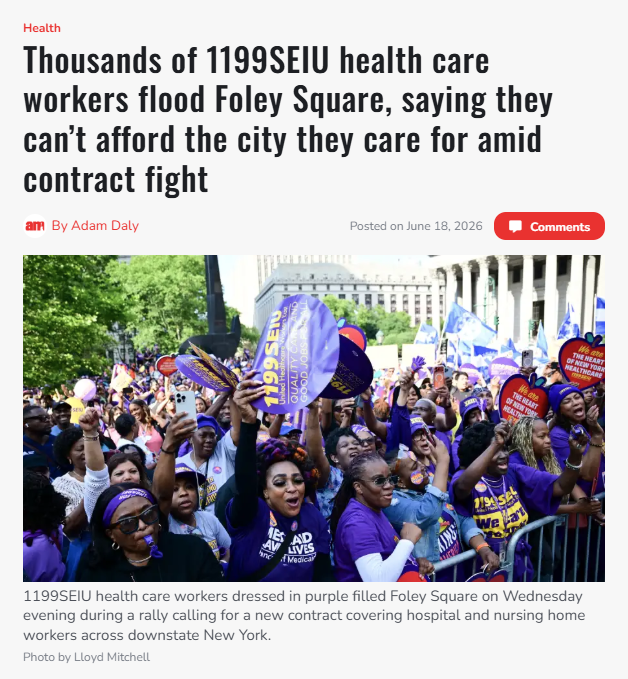
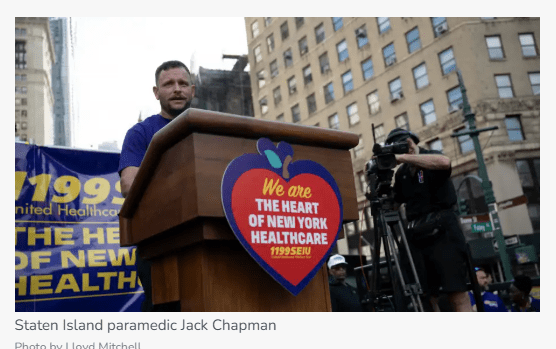
At Wednesday’s rally, Jack Chapman, a Staten Island paramedic, told the crowd that EMS workers are both health care workers and first responders, often bringing emergency care directly to patients in homes and on street corners.
“We are not asking for special treatment. We are asking for fair treatment,” Chapman said, adding that wages have made it difficult to retain experienced EMTs and paramedics.

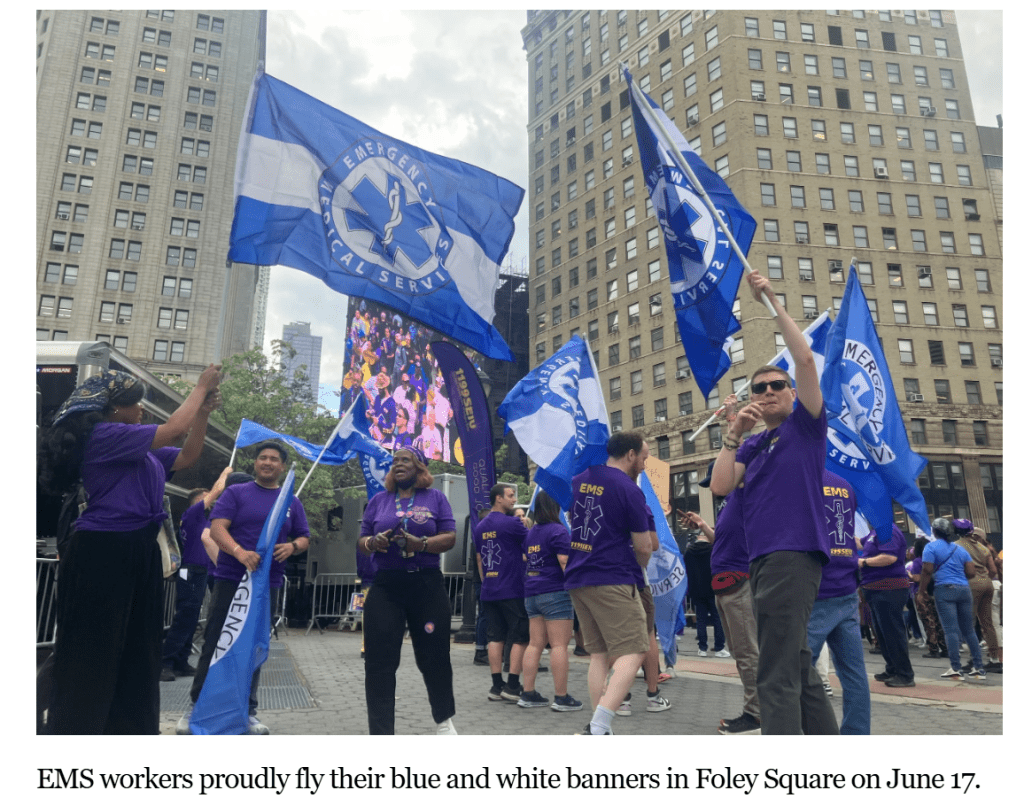
NYC Healthcare Workers to Hospital Bosses: ‘Take the Profit Out of Your Pocket’ — Work-Bites
Staten Island paramedic Jack Chapman looked out over the thousands of fellow 1199SEIU members gathered in Foley Square on Wednesday and talked about how EMS wages have lagged behind the responsibility workers like him carry ever day.
“Too often, EMTs and paramedics are assaulted in the line of duty,” he said. “We have members who have been shot, stabbed, and who have lost their lives—all while helping complete strangers. And yet, despite those risks, we continue to answer every call that comes in, day after day. We are there because people need us.”
Chapman is among 86,000 other 1199SEIU Emergency Medical Service workers, registered nurses, certified nursing assistants, and other caregivers the union represents at 90 downstate hospitals and nursing homes in New York who are demanding the League of Voluntary Hospitals and Homes —the bosses in this labor fight—agree to a fair contract.
“We constantly lose our experienced providers to other careers, usually because of wages, and it should be no surprise that during a medical emergency experience matters,” Chapman continued. “We are not asking for special treatment, we are asking for fair treatment. We want to strengthen the emergency medical care available throughout New York City. That is what we are fighting for today.”
EMSPAC—the Emergency Medical Service Public Advocacy Council—declared on social media following Wednesday’s rally that the League’s latest proposals are “wholly unacceptable” and that the more than 3,000 EMS workers represented by 1199SEIU are ready to “lock arms with our union family across every title” and strike if necessary.
“We will not stand by while hopsital executives attempt to strip away benefits, undermine working conditions, and impose austerity wage structures on the very workers who keep New York’s healthcare system running every day,” the group, which is also dedicated to achieving pay parity for EMS workers, said on Instagram.

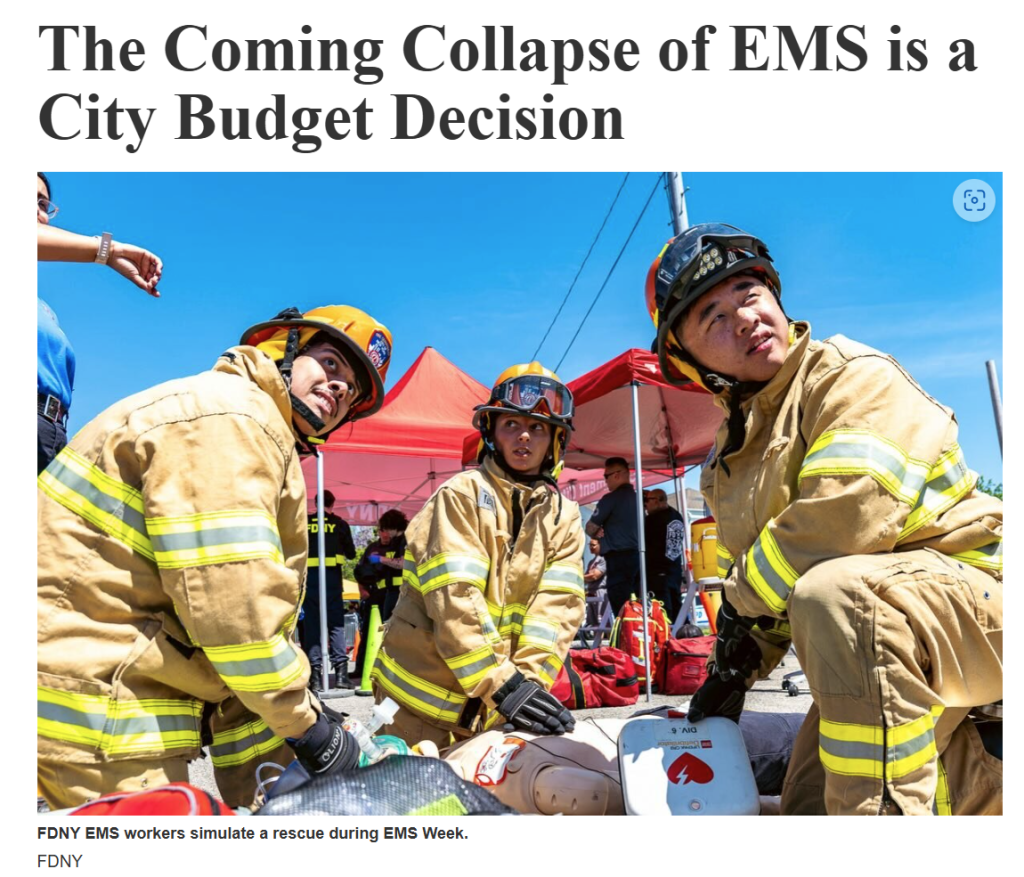
The Coming Collapse of EMS is a City Budget Decision – The Chief
New York City is at a critical crossroads in its emergency response system. That’s a polite way of saying it may collapse this summer. While City Council voices (notably Speaker Julie Menin and Fire and Emergency Management Chair Joann Ariola) advance a proposal to add a fifth firefighter to engine companies at an estimated cost of $91.7 million annually, the city’s 911 EMS system continues to face a deepening crisis of deep understaffing, burnout, and low wages.
FDNY EMS, paramedics and EMTs, respond to roughly 85 percent of all 911 calls, including overdoses, cardiac arrests, shootings, and psychiatric emergencies. Yet despite carrying the overwhelming majority of emergency workload, EMS remains the lowest-paid branch of the FDNY.

We previously covered this issue in some detail, and this weekend we are bringing you an interview with a representative of EMSPAC, an organization seeking to unite all of the different EMS workers serving this great city and fight for better wages, benefits, and safer workplaces (to the extent that this can be controlled).
They say it will get much worse before it gets a little better. They also say without struggle there can be no progress. And the struggle must go on.
Together, we wrote an EMS Bill of Rights to remind you that what we do as a national service has a future.
EMS cannot continue running on sacrifice alone. Passion does not pay bills. “Heroes” still need healthcare, retirement, safe staffing and livable wages.
Every respected profession fought for what they have.
EMS must stop surviving quietly and start standing together loudly.
United EMS saves lives — including our own.
The FDNY gave us four-digit salaries. And then we were tasked to save lives. But who was there to watch after us?
After all that training to “save lives” that they put into us, we found that we could not fully provide for our families, or easily pay our rent. We found that we were of no value to this city’s government, though its citizens call us day and night. We found ourselves working all the time, in the business of human suffering.
We were taught to be heroic and to get ready “for when the next shoe fell” upon this city. Be fearless in our work, but also ever compassionate. They said our work was “different” and we did not have the same risks as the firefighters or police.
So for 30 years no one tried to make us full-fledged first responder.
And then one of us went up a mountain alone and died in a snow storm. One of us was found dead in a basement. A few thousand of us have been spit on or punched in the face. One of us was murdered, run over by an ambulance.

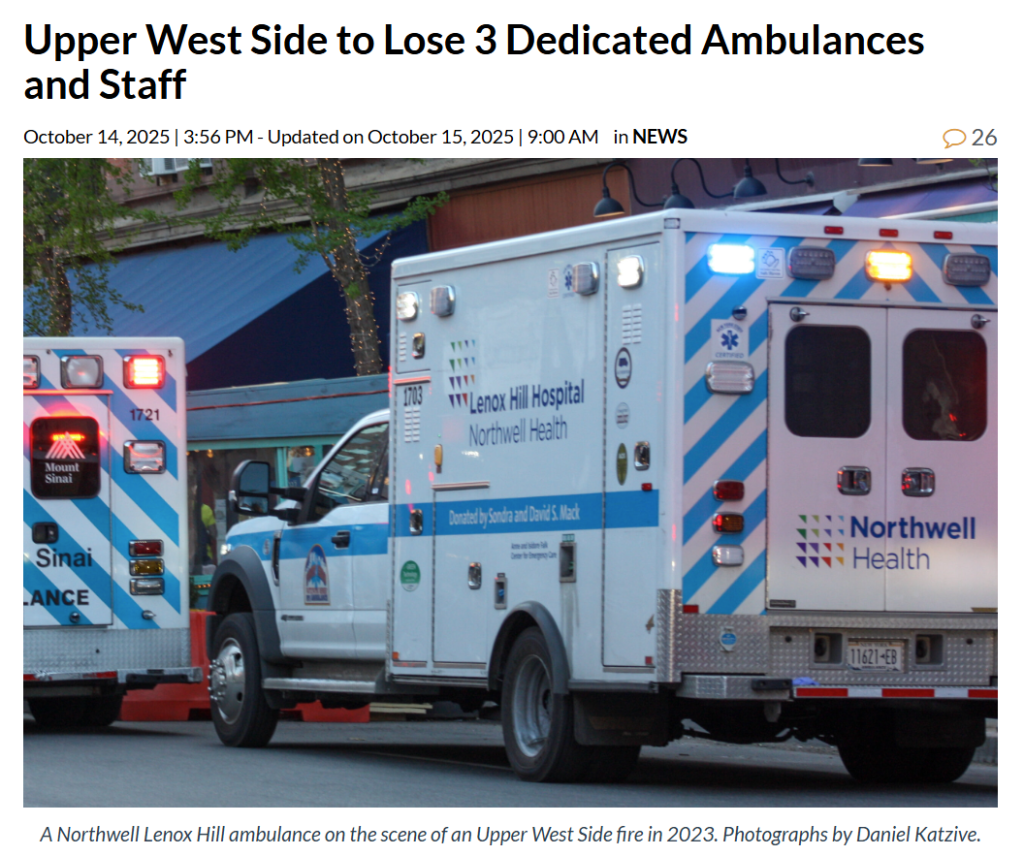
Upper West Side to Lose 3 Dedicated Ambulances and Staff
Northwell Health’s Lenox Hill Hospital is laying off or reassigning 18 staff members and shutting down two advanced life support and one basic life support ambulances, covering the Upper West Side up to Washington Heights, according to the Emergency Medical Service Public Advisory Council (EMSPAC), a nonprofit supporting the 15,500 municipal and privately employed EMS workers in New York City.
The trio of removed ambulances units from the Upper West Side were previously stationed at Columbus Avenue and West 72nd Street, Columbus Avenue Avenue and West 85th Street, and a third near the American Museum of Natural History, according to New York City Councilmember Gale Brewer, who penned a letter on Friday to Northwell Health, protesting their removal.
The three units are capable of responding to approximately 60 calls per day, estimates Walter Adler, EMSPAC’s president and a paramedic and union delegate working at another private hospital system in the city. “Is it gonna break the system overnight? Absolutely not. But it is a problematic variable in how New Yorkers get emergency care over time. The city doesn’t really want to pay its employees, and the hospitals are absolutely looking at the ambulances from the perspective of finances,” says Adler.
Empty rhetoric on EMS – The Chief
The NYC EMS system collapsed during the Covid pandemic. It really cannot be put any other way. Over 48,000 New Yorkers died. Over 40 percent of the EMS staff went out sick from exposure. We ran out of available units as volume spiked above 6,500 per day. Hundreds of FEMA units from the private sector had to be called in from outside.
In short, in under two months, the pandemic broke NYC EMS. But it also changed for a time the way the public thought about our work and how we thought about ourselves. Briefly, there was a widespread belief we all did something important, essential, maybe even heroic. The majority of NYC EMS kept coming to work and kept doing jobs, despite not having any clear picture of how serious the risks were.

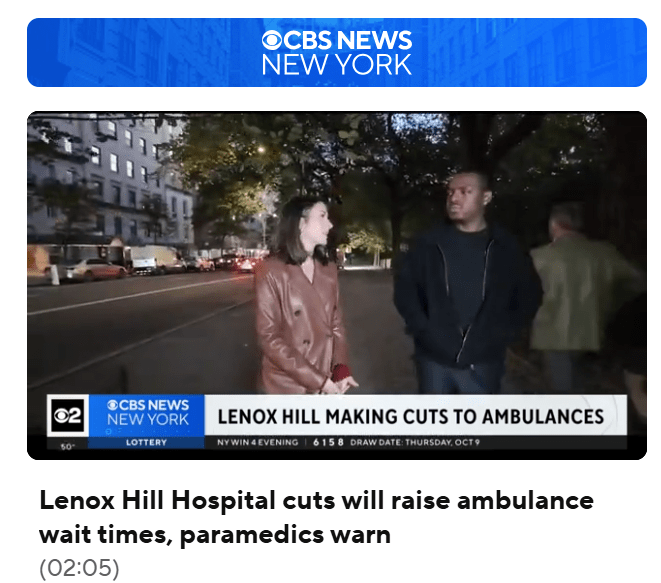
Manhattan paramedics are warning New Yorkers they may soon have to wait longer for an ambulance to arrive after an Upper East Side hospital made cuts to its fleet.
About a dozen paramedics at Northwell Health’s Lenox Hill Hospital received a letter Thursday stating their positions will be eliminated in 30 days “due to operational needs of the hospital.”

Northwell Axes 3 Ambulances, 18 Emergency Workers at Lenox Hill Hospital
“With this decision, they’re losing the vision of what being a steward of public safety entails,” said Jahrodney Williams, a paramedic and a union rep for 1199 SEIU, which represents about 70% of EMS employees at Lenox Hill Hospital. “I think it’s incredibly short-sighted, and it’s going to hurt a lot of people in the long run,” said Williams.
The Emergency Medical Services Public Advocacy Council (EMSPAC) argued that Northwell’s layoffs have come in response to the increased unionization of ambulance workers in the city.
“The sudden announcement of EMS lay-offs has a public safety impact as well as raises issues of Northwell’s open and notorious contempt for 1199 SEIU’s expansion into its ambulance service,” EMSPAC said. “Northwell has a propensity to shut down the 911 units at garages represented by 1199 SEIU, while incrementally pulling out of the 5-borough 911 system.”
Walter Adler, a paramedic with NYU Langone, a 1199 SEIU member, and an EMSPAC volunteer, said he believed Northwell was cutting staff for three reasons. The first is federal cuts to healthcare spending. The second reason, Adler said, is that it isn’t financially beneficial for Northwell ambulances to transport patients to hospitals not owned by their network. He also suspects that Northwell objects to unionization of the city ambulances.
“Northwell has defeated two attempts in the last 10 years to unionize its 800 Long Island EMS employees,” Adler said. “No huge employer in America wants a powerful, militant trade union.”


Op-Ed | This is why ambulances were slower in 2025 | amNewYork
I will tell you exactly why it’s taking longer to get an ambulance in 2025. No one wants to work in a field where we are paid inadequately for high risk and stress. So everyone is leaving the FDNY EMS, which is still only able to cover ⅔ of the actual 911 call volume. The City, the Hospitals, and the private sector are refusing to compensate EMTs and Paramedics, while the call volume is only increasing. You have an increasing demand for EMS services while the supply of providers is diminishing. You have an entire workforce with one foot out the door. In short, City Hall does not seem to think a uniformed EMS service is essential to invest in. “Essential” means a budgetary allocation that accounts for the fact that the public expects an ambulance. The 911 medical response is fractured. The risks to human life are real. What is not really being talked about is how much money ambulances generate.

EMS peer support program included in budget – The Chief
The city’s 11,000 EMS workers will soon have access to wellness programs, helping them better contend with the traumatic situations they deal with on a near-daily basis.
The programs, instituted through a $1 million pilot initiative backed by the Council’s Progressive Caucus as part of its “Crisis to Care” platform, was included in the city’s Fiscal Year 2026 budget.
One of the pilot’s biggest beneficiaries will be the Regional EMS Council of New York City, which has run a peer support program since 2001. The money will be used to “aggressively expand” REMSCO’s 24/7 peer support hotline by expanding the peer support team and training more EMS workers, the not-for-profit’s executive director, Joseph Raneri, said in an interview.
“One of the challenges that’s always existed with that team is to get real dedicated funding and to get consistent funding to ensure the team’s operations,” he said of the support program. “We’re happy that the city is acknowledging this is a need, and happy that our EMS professionals are finally getting some of the support that they need that’s been long overdue.”

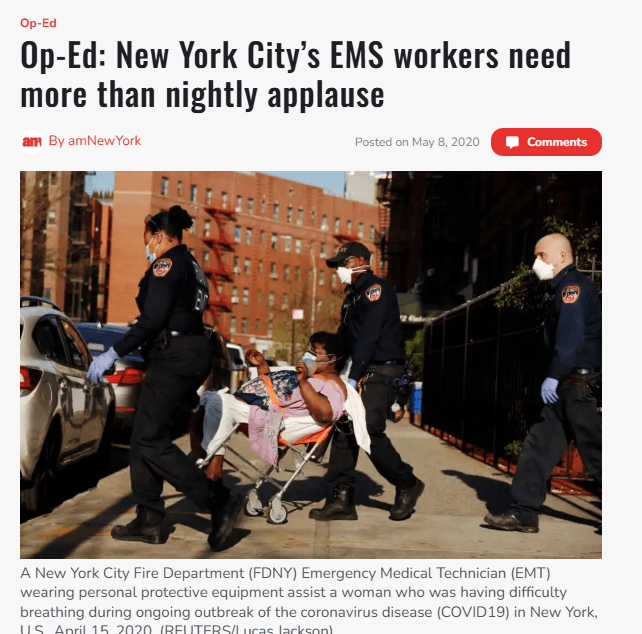
Op-Ed: New York City’s EMS workers need more than nightly applause | amNewYork
Over 14,000 New Yorkers have died so far during the COVID-19 pandemic. A lot of bravery, heroism and inter-agency cooperation has ensued for the worst four weeks of the pandemic. The virus is here and will be for some time. My EMS brothers and sisters will continue to help hold the front lines.
But when the coughing stops and the fevers cool, will the inequities be addressed? EMS workers need profession-wide protections. We need to be compensated in parity with policemen and with firefighters. We need leadership to bring the disparate sectors of the field together in common purpose to advocate for political action to resuscitate this field. For decades we have been there at critical moments of loss and terror, laying down our lives for our patients and their families.

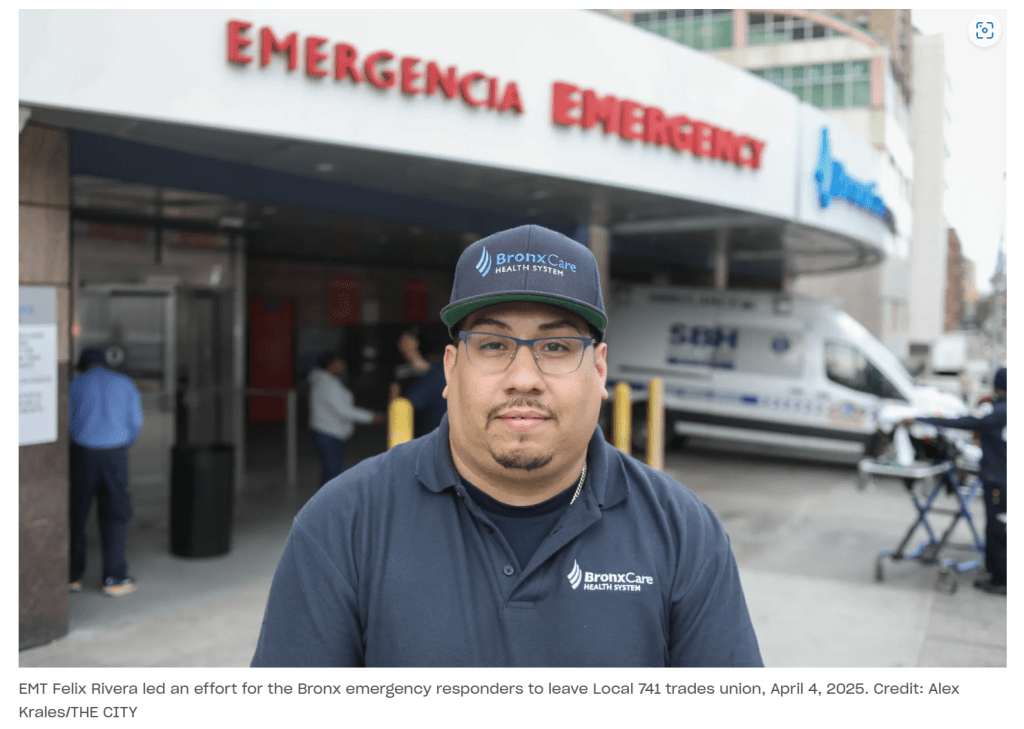
How a Group of EMTs Made a Speedy Escape From a Boss-Friendly Union | THE CITY — NYC News
For years, workers at Citywide Mobile Response, a Bronx-based ambulance service, griped about what they described as their absentee union. Whenever medical equipment and safe trucks were in low supply, they said, their complaints to management fell on deaf ears — and their union was nowhere to be found.
The frustrations led to a campaign to kick out their union, Local 741 of the Specialty Trades Union, and join a new one — but they had to move quickly, with just a 30-day window under federal labor law to make their escape.
In just five days in late January, Citywide workers gathered signatures from more than half of their 200-plus colleagues, exceeding the 30% required to request an election with the National Labor Relations Board. They prevailed in a blowout election on March 6, voting 116 to 14 to kick out their union, Local 741 of the Specialty Trades Union, and join 1199SEIU. Eight more workers voted to not have a union at all.

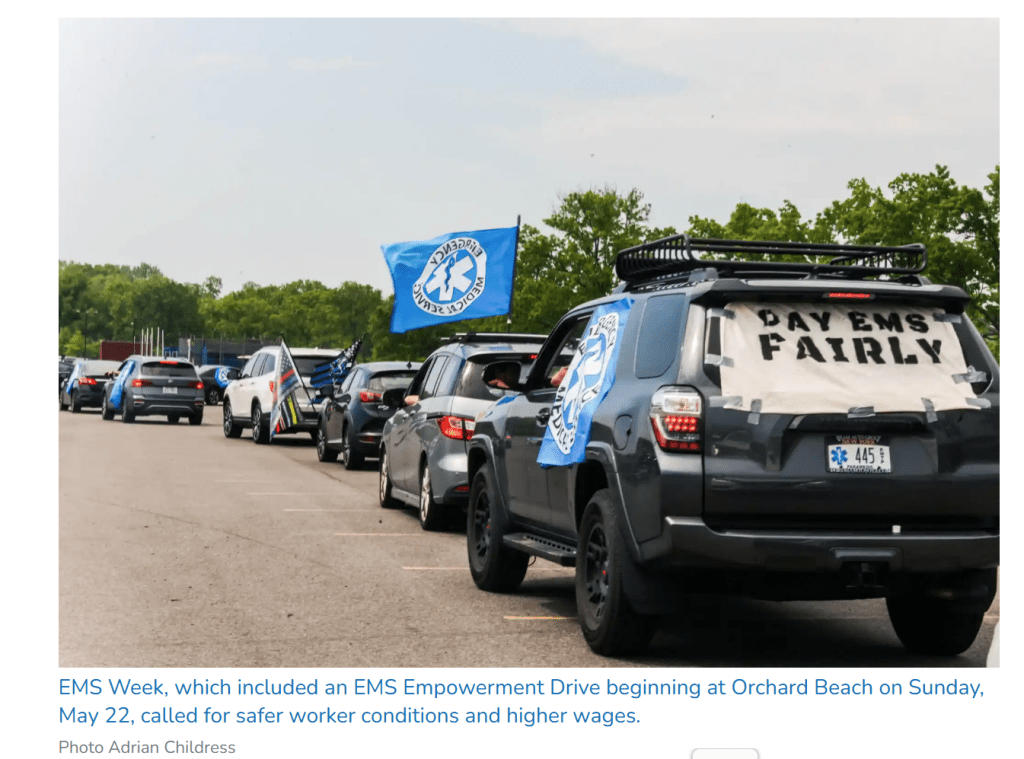
Last week’s EMS Week brought much-needed visibility for New York’s emergency medical services, which are dealing with over-exhaustion of their workforce and a rise in assaults since the pandemic. Over the weekend, a caravan of New York’s paramedics and emergency personnel drove through the Five Boroughs — converging on Queens’ Flushing Meadows Park — calling for higher pay and safer worker conditions.
Roughly 70,000 EMS professionals across New York state respond to more than 3.5 million calls for care per year, including providing emergency medical services to more than 150,000 ill or injured children each year. However, their pay has stagnated — despite reaching an agreement with the city to boost salaries last fall — behind their peers in the NYPD and FDNY.

4th Annual EMS Leadership Summit | EMS Leadership Academy
Walter Adler, Chief Advocacy Officer of EMSPAC – Building a National EMS Labor Association controlled by Active Duty EMS

Former FDNY EMT creates advocacy group
EMS1 — A former FDNY EMT has created the first citywide advocacy group for EMS. The group is named Banshee for Irish ghoul that appears and wails to foretell a person’s death.
“It’s a twist on the myth — we go and hopefully save someone’s life before they die,” Adler said.
He says Banshee aims to fight for higher pay and better conditions for paramedics and EMTs.
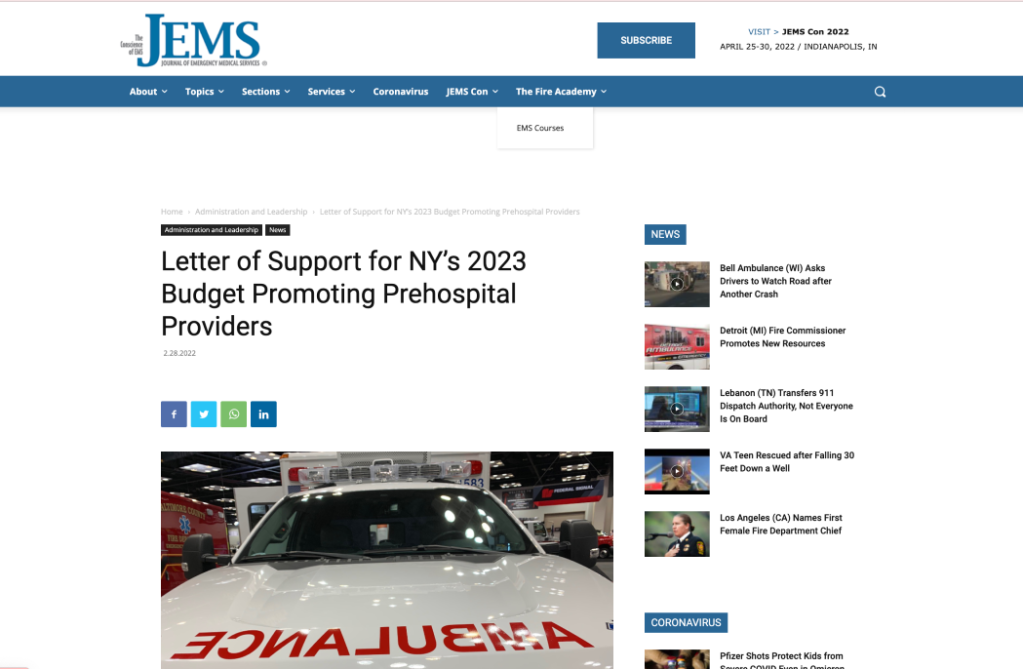
“Despite NYSNA’s allusion to a dangerous future of poorly trained and unsupervised paramedics that run amok in the hospital, they are adept and educated clinicians who already fulfill roles beyond the limited scope that the NYSNA suggests.
In addition, the budget language specifically calls for increased oversight of EMS and direct supervision from physicians as a team approach in patient care. EMSPAC opposes the NYSNA stance stating EMS should be limited in their location and craft to emergencies that must be transported to the hospital…”
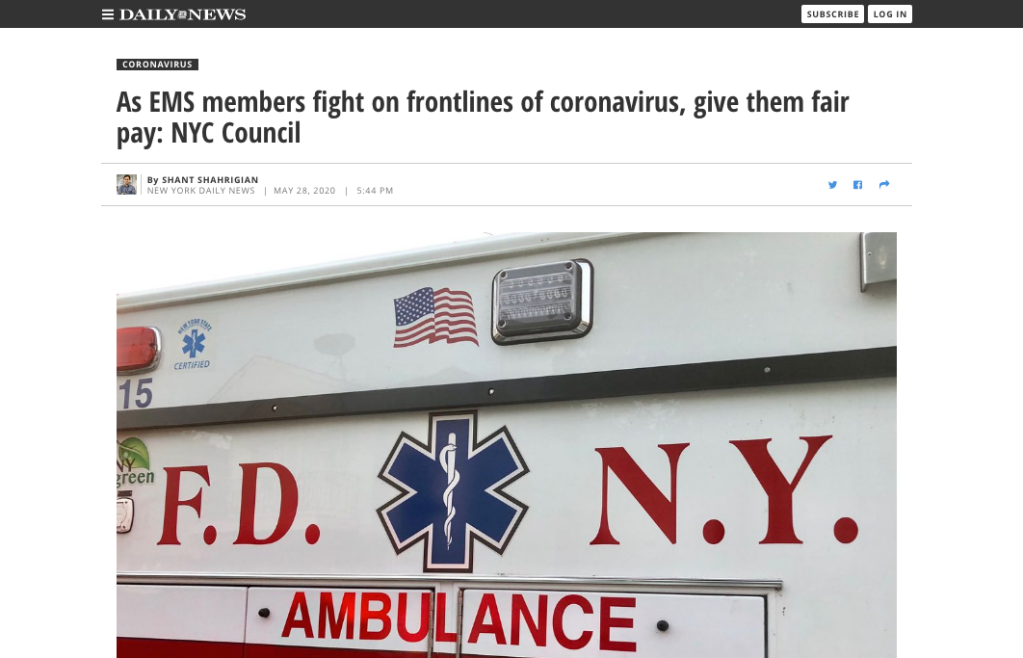
“It’s more important than ever to give fair pay to EMS members, NYC lawmakers said Thursday.
The City Council unanimously passed a resolution calling for those first responders to be paid comparably to firefighters and police officers.
‘Our EMS personnel have worked endless shifts even before this pandemic began,’ Council Speaker Corey Johnson said at a press conference. ‘They are not paid fairly for this work and since the pandemic began, they remained on the frontlines, meeting the medical needs of New Yorkers.’…
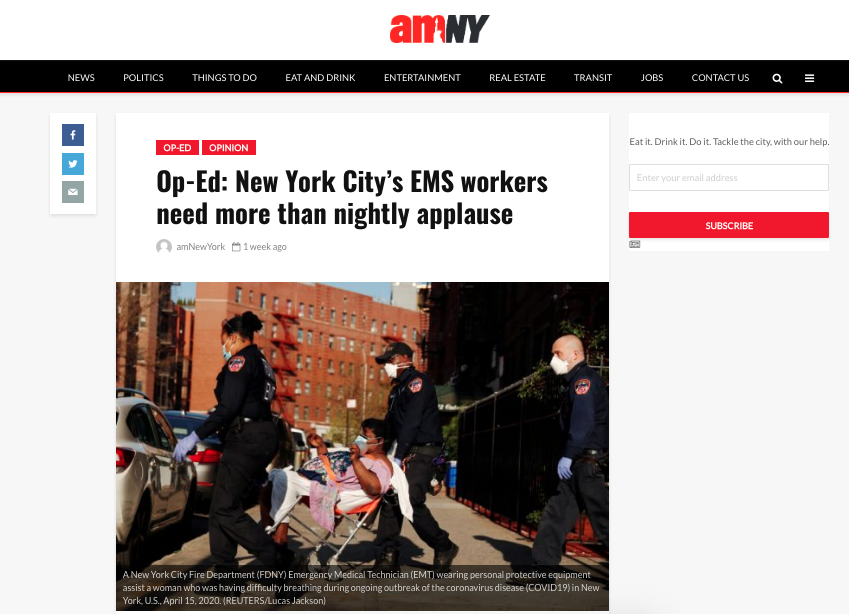
“Over 14,000 New Yorkers have died so far during the COVID-19 pandemic. A lot of bravery, heroism and inter-agency cooperation has ensued for the worst four weeks of the pandemic. The virus is here and will be for some time. My EMS brothers and sisters will continue to help hold the front lines.
But when the coughing stops and the fevers cool, will the inequities be addressed? EMS workers need profession-wide protections….”
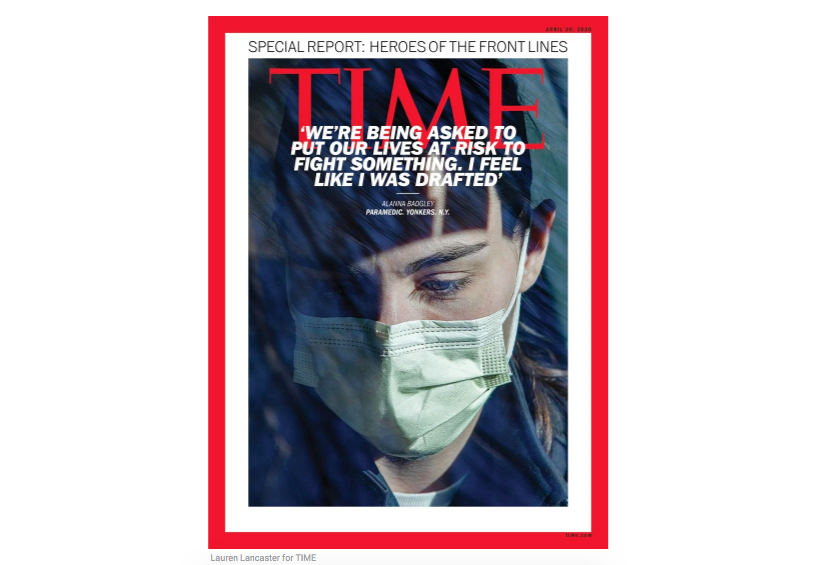
“…Badgley knows the woman needs oxygen fast, but she doesn’t want to do anything that could spray the virus and infect others. She gives her nasal oxygen as she wheels her to the ambulance, and then an oxygen mask once they get inside the bus: she knew the nurses would probably intubate her at the hospital. As soon as her oxygen levels come up in the ambulance, the woman starts to improve enough to mumble her name. “Hold my hand, hold my hand, hold my hand,” Badgley says. “It’s okay.”

“Before the virus, the city’s 911 system typically got about 4,000 EMS calls per day. On March 26, it received over 7,000, a call volume unseen since 9/11. Since early March, EMS workers have become stricken with COVID-19 putting a strain on an already strained profession, blighted by high turnover rates due to low salaries and a lack of benefits. In 2018, the FDNY promoted 900 EMS to firefighters, which many EMTs find hard to turn down due to the significantly higher salary, causing an even greater staffing shortage…”
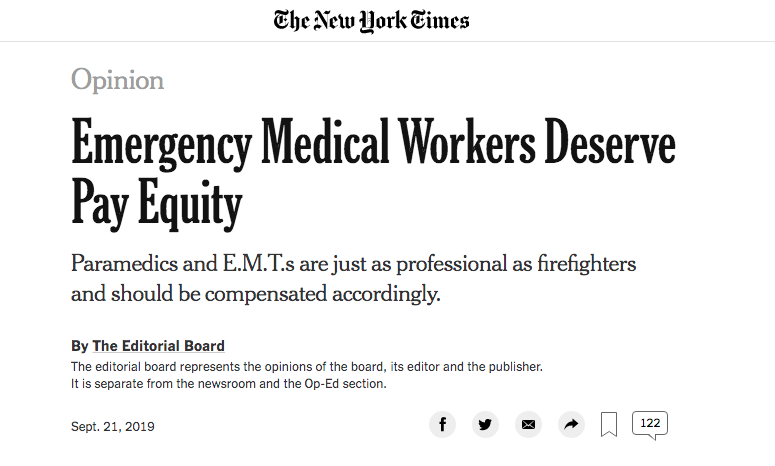
“The benefits are also different. Firefighters have unlimited sick pay, for example, while paramedics and E.M.T.s — who regularly come into contact with sick patients — have 12 days of paid sick leave every year.
The unions that represent E.M.T.s and paramedics have fought to close the gap, pointing to the growing workload and arguing that they face some of the same dangers as firefighters…”
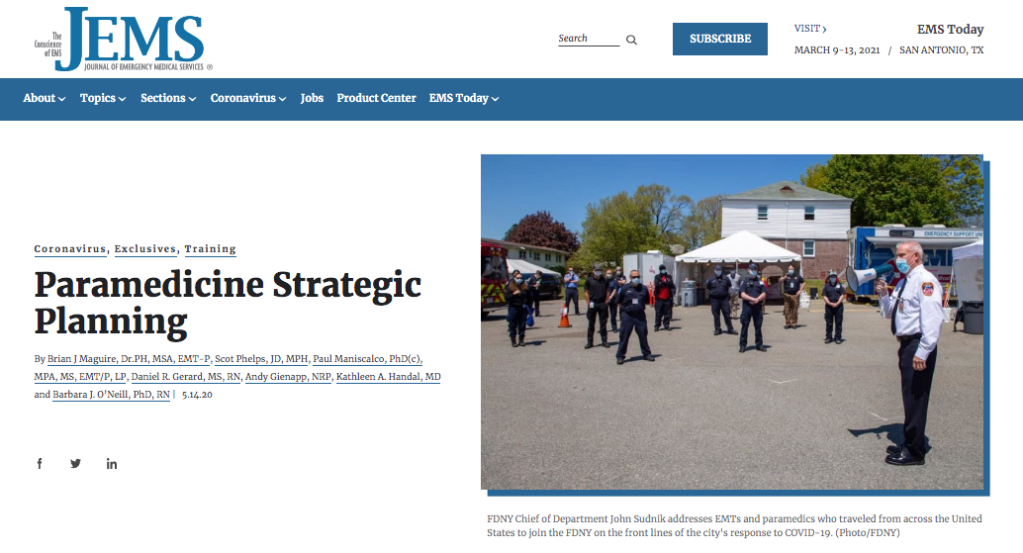
“In the United States, the system that was once among the most advanced in the world, has been largely abandoned by government leaders and funders, and has been left to languish for more than four decades. The outcome of this dangerous neglect has become obvious as the COVID-19 pandemic unfolds.
As a result of this lack of vision, lack of investment and lack of a rational finance model, the system is only marginally integrated into disaster mitigation, planning, response and recovery…”
“A well-functioning emergency medical service (EMS) is a matter of life or death for New Yorkers…
The City of New York spends more than $1.1 billion annually in an effort to provide its residents and visitors this vital service, but the money is not used wisely. The system suffers from serious inefficiencies, and major reforms are needed to make it work better…”
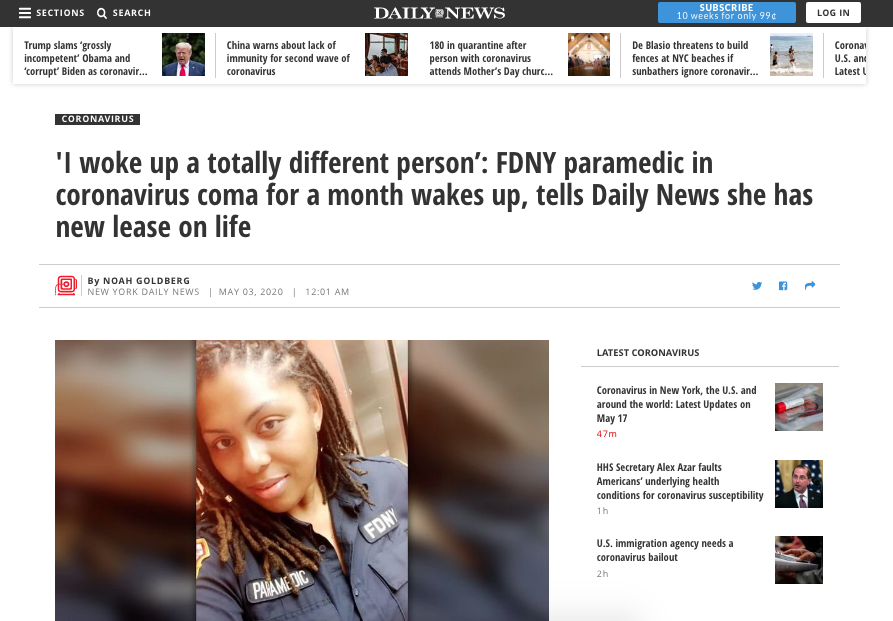
“The last thing FDNY paramedic Christell Cadet remembers was telling doctors she could no longer breathe on her own.
That was on March 21, when the 34-year-old was placed in a medically-induced coma while fighting for her life against a crippling coronavirus infection…
‘I woke up a totally different person,’ Cadet told the Daily News, her voice still hoarse and weak. ‘I’m not the same person I was before this started. Mentally, it makes me look at things different. It makes me appreciate life in a different way’…”

